
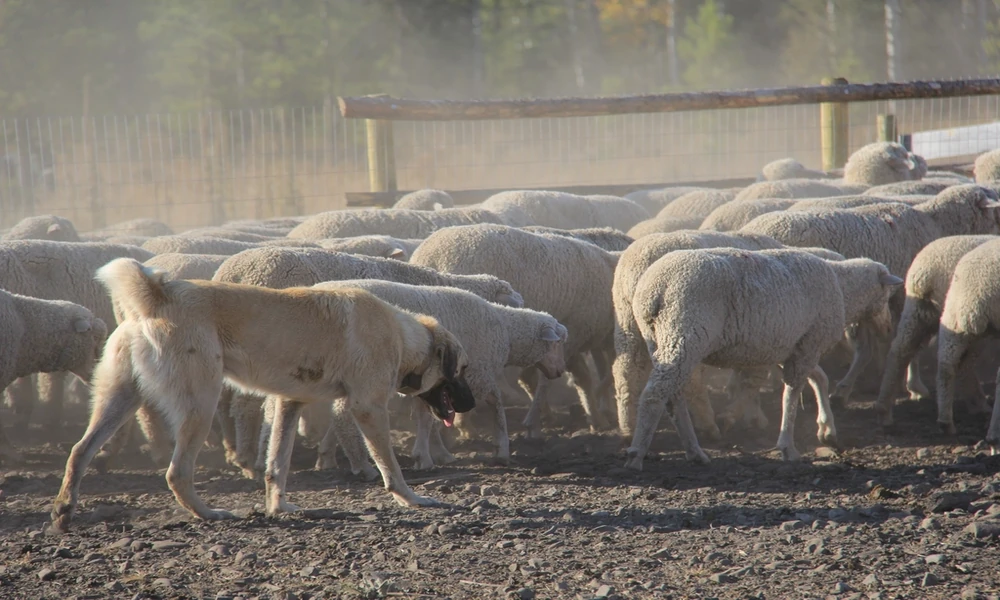
Photo: “Livestock protection dogs (LPD),” U.S. Department of Agriculture, via rawpixel, public domain (CC0).
When most people picture a guard dog, they imagine a German Shepherd patrolling a yard. On farms and ranches, the most effective guards look very different. Livestock guardian dogs are large, usually pale-coated breeds that live with sheep, goats, or other animals day and night, warning off coyotes, wolves, bears, foxes, and stray dogs.
They’re one of the oldest forms of livestock protection, and in the US they’ve become a mainstream tool for sheep and goat producers. In the UK, where large predators are absent, they’re less common but are used by some smallholders and farmers dealing with foxes and dog attacks.
How guardian dogs work
Livestock guardian dogs don’t herd. They’re raised alongside the animals they protect, so they treat the flock as their own group and defend it. According to Texas A&M AgriLife Extension’s guide to livestock guardian dogs, properly reared guardian dogs are exposed to livestock from birth, and they can prevent predation by deterring predators all the time, rather than responding after losses have already happened.
Most of their work is deterrence: patrolling, scent marking, barking, and placing themselves between the flock and a threat. Physical confrontation is usually a last resort.
Texas A&M AgriLife has described well-placed, well-managed guardian dogs as “undeniably among the best long-term tools available to manage predators for sheep and goats.”
Common breeds
The main breeds come from Europe and Asia, where they’ve guarded flocks for centuries. In the US and UK, the most common include the Great Pyrenees, Anatolian Shepherd, Maremma Sheepdog, Akbash, Kuvasz, Komondor, and Kangal, along with crosses of these breeds.
Research suggests breed can affect results. A study published in Rangeland Ecology & Management found that three less common breeds, the Kangal, Karakachan, and Transmontano, were all associated with overall reductions in sheep losses of between 61% and 95% compared with mixed-breed guardian dogs. Individual temperament, rearing, and management still matter as much as breed.
Raising a guardian dog
Good guardian dogs are made as much as born. Puppies are usually raised with the livestock from a young age, often in a lambing or kidding barn, so they bond with the animals. They need supervision during their first year or two, when playfulness can lead to chasing or injuring stock.
Training focuses on attentiveness to the flock, gentle behaviour with young animals, and returning when called. Many owners use two or more dogs, so they can cover larger areas and back each other up against bigger predators.
What to expect day to day
Guardian dogs are independent thinkers, bred to make their own decisions without a handler. That makes them very different from obedience or protection breeds. They often don’t respond reliably to commands, can be wary of strangers, and may challenge visitors who enter the pasture.
They also bark, often at night, when predators are most active. Neighbours living close by may not appreciate it, so location and boundaries matter. Many guardian dogs roam if fencing isn’t secure, extending their territory well beyond the farm.
Good fencing, regular vet care, adequate food and shelter, and daily contact with the owner keep guardian dogs healthy and manageable.
The UK context
The UK has no wolves or bears, and most predation comes from foxes, badgers in some areas, birds of prey taking young lambs, and, most significantly, dogs attacking sheep. Sheep worrying by pet dogs is a serious problem, and the Dogs (Protection of Livestock) Act 1953 makes it an offence for a dog to worry livestock on agricultural land.
Guardian dogs can deter foxes and loose dogs, but their size, barking, and independence can be challenging on small UK farms near footpaths and villages. Some UK smallholders choose alternatives such as llamas or alpacas, which also guard sheep against foxes.
Guardian dogs are not home protection dogs
Buyers sometimes look at guardian breeds as family protection dogs. They’re very different from trained protection dogs. Guardian breeds are bred to live with livestock, act independently, and guard territory, not to respond to a handler’s commands. In a suburban home, without a flock and a large territory, many become bored, noisy, or difficult to manage.
Buying a guardian dog
Buyers can improve their chances of success by choosing pups from working parents that live with livestock, rather than pet or show lines. Ask how the pups have been raised, whether around stock, and how the parents behave with animals and people. Experienced adult dogs, already working with livestock, can also be a good option for first-time owners.
Questions to answer first
Before buying, farmers and smallholders can ask themselves a few questions. Which predators are we dealing with, and how serious are the losses? Is our fencing secure enough to keep a guardian dog on the property? How close are neighbours and public footpaths? Do we have time to raise and supervise a pup for its first year or two? And would one dog be enough, or do we need two?
Chosen and managed well, guardian dogs can protect a flock around the clock for many years.